> NBA History > Wolves History >
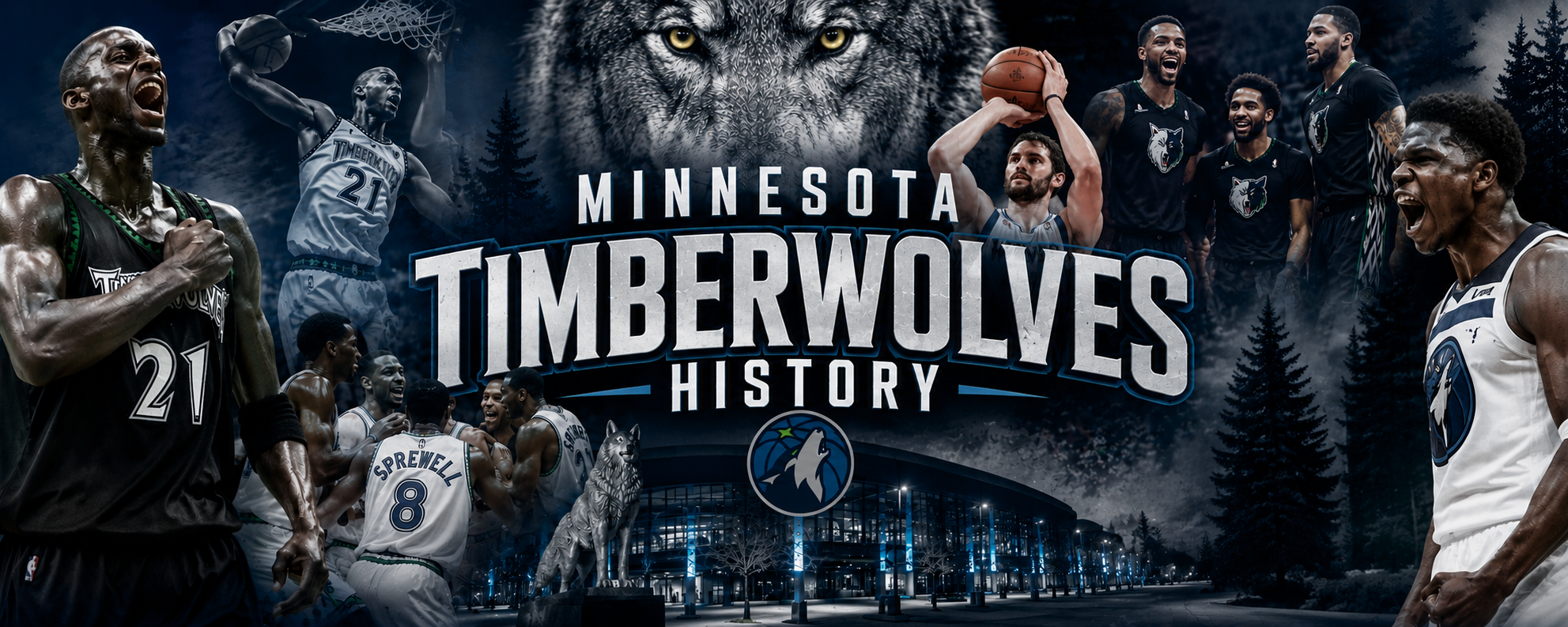
History of the Minnesota Timberwolves
The Minnesota Timberwolves joined the National Basketball Association as an expansion franchise in 1989, along side the Orlando Magic, bringing professional basketball back to the state of Minnesota after the departure of the Minneapolis Lakers to Los Angeles in 1960. While the franchise struggled through much of its early history, the Timberwolves eventually became contenders behind Hall of Fame talent and have emerged as one of the NBA's rising powers.
NBA Returns to Minnesota
Professional basketball has deep roots in Minnesota. The Minneapolis Lakers won five NBA championships during the 1950s before relocating to Los Angeles in 1960. For nearly three decades, Minnesota was without an NBA team.
That changed on April 22, 1987, when the NBA awarded an expansion franchise to a group led by businessman Harvey Ratner and Marv Wolfenson.
A statewide "Name the Team" contest produced the nickname "Timberwolves," reflecting Minnesota's large population of gray wolves and the state's northern wilderness.
The Timberwolves began play during the 1989–90 season.
Early Growing Pains (1989–1995)
The franchise played its first five seasons in the Hubert H. Humphrey Metrodome, becoming one of the NBA's biggest attendance draws despite consistently losing seasons.
The expansion roster struggled to compete against established NBA teams. The Timberwolves failed to win more than 29 games in any of their first six seasons and cycled through several coaches and front-office changes while searching for a foundation.
Notable early players included:
Tony Campbell
Tyrone Corbin
Doug West
Christian Laettner
The Kevin Garnett Era (1995–2007)
Everything changed in the 1995 NBA Draft when Minnesota selected Kevin Garnett with the fifth overall pick.
Garnett became the first player drafted directly from high school in two decades and quickly developed into one of basketball's greatest all-around players.
Under Garnett, the Timberwolves became a perennial playoff team.
Highlights included:
Eight consecutive playoff appearances (1997–2004)
Multiple 50-win seasons
Garnett winning the 2004 NBA Most Valuable Player Award
Garnett becoming the franchise's all-time leader in nearly every major statistical category
During this era the Wolves added stars such as:
Stephon Marbury
Wally Szczerbiak
Sam Cassell
Latrell Sprewell
The 2004 Western Conference Finals
The 2003–04 season remains one of the greatest in franchise history.
Led by Garnett, Sam Cassell, and Latrell Sprewell, Minnesota finished with a franchise-best 58–24 record.
Garnett captured the NBA MVP award after averaging:
24.2 points
13.9 rebounds
5.0 assists
The Timberwolves defeated the Denver Nuggets and Sacramento Kings before advancing to their first-ever Western Conference Finals.
There they lost to the Los Angeles Lakers in six games.
It remains one of the defining seasons in franchise history.
Drought Years (2007–2020)
Following years of playoff disappointment, Minnesota traded Kevin Garnett to the Boston Celtics in 2007.
The Timberwolves entered another rebuilding phase marked by frequent coaching changes and high draft picks.
Key players during this period included:
Kevin Love
Ricky Rubio
Karl-Anthony Towns
Andrew Wiggins
Jimmy Butler
The Timberwolves finally ended a 13-year playoff drought in 2018 but were eliminated in the first round.
The Anthony Edwards Era
The franchise selected Anthony Edwards with the first overall pick in the 2020 NBA Draft.
Edwards rapidly developed into one of the league's brightest young superstars thanks to his explosive scoring, athleticism, and charismatic personality.
Minnesota also acquired three-time Defensive Player of the Year Rudy Gobert, pairing him with Karl-Anthony Towns to form one of the NBA's biggest frontcourts. Gobert would go on to become the first player in Minnesota Timberwolves history to win the DPOTY award as a member of the team, doing so in 2024
Return to Contention
After several years of growth, the Timberwolves emerged as one of the NBA's elite teams.
The 2023–24 season marked a breakthrough as Minnesota won 56 games, finished near the top of the Western Conference, and reached the Western Conference Finals for only the second time in franchise history. Anthony Edwards established himself as one of the league's premier stars, while Gobert anchored one of the NBA's best defenses.
Although the team fell short of an NBA Finals appearance, the season signaled that Minnesota had become a legitimate championship contender.
Home Arenas
The Timberwolves have played in two home arenas:
Hubert H. Humphrey Metrodome (1989–1995)
Target Center (1990–present)
Target Center has served as the team's permanent home since 1990 and has undergone several major renovations.
Team Achievements
As of 2026, the Timberwolves have:
Joined the NBA as an expansion franchise in 1989.
Won multiple division titles.
Reached the Western Conference Finals twice (2004 and 2024).
Produced one NBA MVP (Kevin Garnett in 2004).
Featured franchise legends including Kevin Garnett, Karl-Anthony Towns, and Anthony Edwards.
Yet to win an NBA championship or reach the NBA Finals.
Legacy
The history of the Minnesota Timberwolves has been one of perseverance and growth. From difficult expansion years to the brilliance of Kevin Garnett and the emergence of Anthony Edwards, the franchise has steadily built a passionate fan base throughout Minnesota. While an NBA championship has remained elusive, the Timberwolves have transformed from one of the league's perennial underdogs into a respected contender with a bright future.
| 